What Is ClaudeBot User Agent? A Complete Guide to Anthropic’s AI Web Crawler
ClaudeBot is Anthropic’s official web crawler that visits websites to collect training data for Claude AI models. As AI systems get smarter, companies like Anthropic use specialized bots to gather publicly available web content. This helps improve their language models’ knowledge and capabilities.
This guide explains everything you need to know about the ClaudeBot user agent—from technical details to practical management strategies.
What Is ClaudeBot?
ClaudeBot is Anthropic’s automated web crawler designed to collect publicly accessible data from websites to train and improve Claude AI language models. The bot moves through web pages systematically, reads content, and stores information that helps Claude understand human knowledge better.
ClaudeBot serves a completely different purpose than crawlers from Google, Bing, or other popular web crawler bots. When Googlebot visits your site, you might see traffic increases from search results. ClaudeBot doesn’t work that way—it takes information but doesn’t send visitors back.
| Feature | ClaudeBot | Search Engine Bots |
|---|---|---|
| Primary Purpose | AI model training data collection | Website indexing for search results |
| Data Usage | Training neural networks | Creating searchable indexes |
| Crawl Frequency | Regular but variable | Continuous with priority-based scheduling |
| Traffic Benefit | No direct referral traffic | Potential search engine visibility |
| Respect for robots.txt | Yes, follows directives | Yes, follows directives |
| User Agent Identification | ClaudeBot/1.0 | Googlebot, Bingbot, etc. |
Why Is ClaudeBot Crawling My Site?
ClaudeBot crawls your website to gather publicly available content that helps train and improve Claude AI models. Anthropic’s crawler prioritizes specific content types that provide training value: informational articles explaining concepts, educational content like tutorials and guides, news and current events, technical documentation, discussion forums containing conversational language patterns, and product descriptions demonstrating commercial writing styles.
Your blog posts and articles are prime targets because that’s where natural language and diverse topics intersect. The bot finds your website through existing links, sitemaps, or web directories, then systematically follows internal links to discover additional pages. It returns periodically to detect content updates.
How to Identify ClaudeBot in Your Server Logs
The ClaudeBot user agent string appears as “ClaudeBot/1.0” in server access logs. The complete user agent string looks like this:
ClaudeBot/1.0 (+https://www.anthropic.com/bot)
Finding ClaudeBot in common server environments:
Apache Server Logs:
grep "ClaudeBot" /var/log/apache2/access.log
Nginx Server Logs:
grep "ClaudeBot" /var/log/nginx/access.log
Windows IIS Logs: Search for “ClaudeBot” in files at C:\inetpub\logs\LogFiles\
To verify legitimate ClaudeBot traffic, perform a reverse DNS lookup—real ClaudeBot IPs resolve to anthropic.com domains. This protects you from spoofed requests, similar to how you’d verify other crawler bots accessing your website.
Why Should You Care About ClaudeBot Activity?
You should monitor ClaudeBot activity because crawler traffic affects server performance, bandwidth costs, and content licensing considerations.
Aggressive crawling creates real operational challenges. Cloud hosting providers charge for data transfer beyond included limits, and large websites may experience hundreds of gigabytes in additional crawler traffic monthly. CPU-intensive dynamic pages require processing for each bot request, and unexpected crawler traffic may trigger auto-scaling mechanisms.
AI training data collection also raises ownership questions. Publicly accessible content may still carry copyright protection, and your original research trains competitor AI models without attribution. There’s ongoing debate about web scraping for AI training and legal issues.
How to Control ClaudeBot Access to Your Sites
You can control ClaudeBot access by using a mix of simple rules and stronger server protections. Start with robots.txt to limit or block crawling, then reinforce it with .htaccess rules and IP address blocking to stop unwanted requests at the server level. Rate limiting helps reduce heavy bot traffic that can strain resources. If you use Cloudflare, you can add an extra layer of control by creating firewall rules, bot management policies, or rate-limit rules that block or challenge requests identified as ClaudeBot before they ever reach your server.
For deeper protection, use CAPTCHA challenges, behavioral analysis, and anomaly detection to identify and restrict automated activity based on how it behaves, not just who it claims to be. Cloudflare’s bot detection and managed challenges are especially useful for spotting unusual request patterns at scale. This layered approach gives you better control over performance, costs, and how your content is accessed.
How to block ClaudeBot using robots.txt
You can block ClaudeBot’s access to your site by adding specific disallow directives to your robots.txt file. This file tells crawlers which parts of your site they are allowed to access. While well-behaved bots usually respect these rules, it’s still the first and simplest line of control. Learn more about using robots.txt to manage bot crawlers.
Complete blocking:
User-agent: ClaudeBot
Disallow: /
Partial access (allow except specific directories):
User-agent: ClaudeBot
Disallow: /private/
Disallow: /admin/
Disallow: /user-data/
Allow only specific sections:
User-agent: ClaudeBot
Allow: /blog/
Allow: /articles/
Disallow: /
How to block ClaudeBot using .htaccess
You can block ClaudeBot at the server level using .htaccess, which is more effective than robots.txt because it actively stops requests instead of just advising the bot.
Block by User-Agent
Add the following to your .htaccess file:
RewriteEngine On
RewriteCond %{HTTP_USER_AGENT} ClaudeBot [NC]
RewriteRule .* - [F,L]
This denies access to any request identifying itself as ClaudeBot.
Block by IP Address. If ClaudeBot traffic comes from known IP ranges, you can block them directly:
Require all granted
Require not ip 123.123.123.123
(Replace the IP with the actual address.)
Important note: User-agent blocking can be bypassed if the bot changes its identifier, and IPs may change over time. For best results, combine .htaccess rules with rate limiting or firewall protections.
How to block ClaudeBot using Nginx
You can block ClaudeBot in Nginx by denying requests based on its user-agent or IP address. This method stops the traffic at the server level and is more effective than robots.txt.
Block by User-Agent
Add this to your server or http block:
if ($http_user_agent ~* "ClaudeBot") {
    return 403;
}
You can also implement this code;
# Block ClaudeBot
if ($http_user_agent ~* (ClaudeBot|anthropic-ai)) {
    return 403;
}
After changes Save the file and reload Nginx:
sudo nginx -s reload
Verify It’s Working
You can test with curl:
curl -A "ClaudeBot" https://yoursite.com
Note: User-agent and IP blocking both require maintenance, as bots can change identifiers or addresses. For stronger protection, combine this with rate limiting or firewall rules.
How to Block ClaudeBot Using Cloudflare
You can block ClaudeBot through Cloudflare by creating custom firewall rules. Cloudflare sits between visitors and your server, filtering traffic before it reaches your infrastructure.
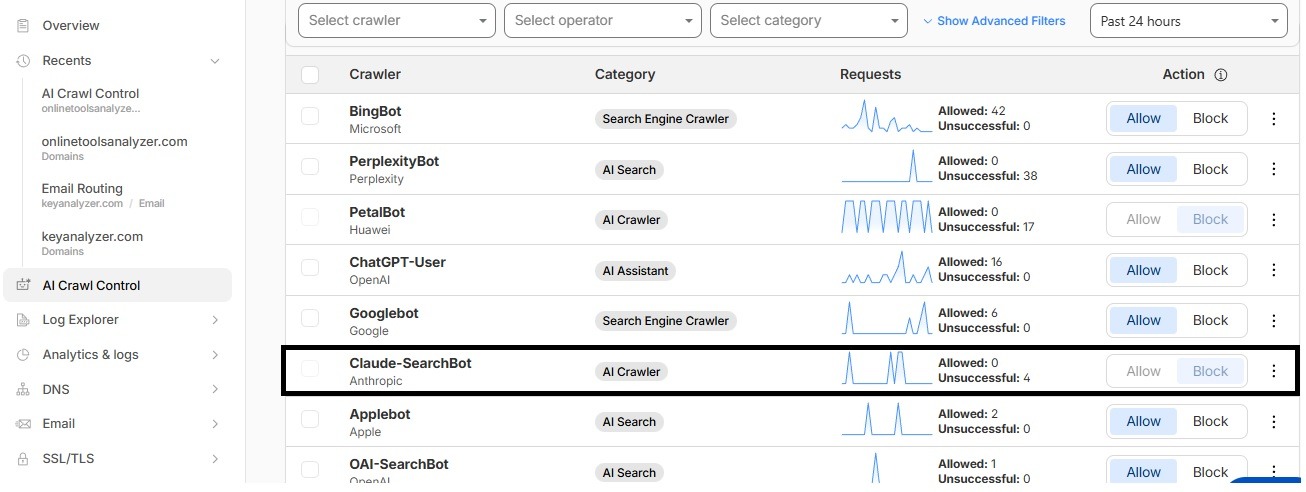
Using Cloudflare Firewall Rules:
- Log in to your Cloudflare dashboard
- Select your domain
- Navigate to Security → WAF
- Click “Create rule.”
- Configure: Field: User Agent | Operator: Contains | Value: ClaudeBot
- Choose action: Block, Challenge, or Managed Challenge
Rate Limiting Instead of Blocking: If you don’t want complete blocking, create a rate limiting rule at Security → WAF → Rate limiting rules. Limiting ClaudeBot to 10-20 requests per minute works well for most sites.
Testing your configuration:
curl -A "ClaudeBot/1.0" https://yourwebsite.com
You should receive a 403 Forbidden response instead of your normal content.
Benefits and Drawbacks of Allowing ClaudeBot
- Benefits: Allowing ClaudeBot enables your content to contribute to Claude AI’s knowledge base. Your expertise may influence AI-generated answers, users might seek out your site after AI conversations, and you position your content for the shift toward AI as a primary information source.
- Drawbacks: Unlike search engine crawlers, ClaudeBot doesn’t send traffic back—no referral visitors, no advertising revenue, no conversion opportunities. You pay server costs to serve content that generates no direct revenue. Your original research trains commercial AI products without attribution or compensation.
How ClaudeBot Compares to Other AI Crawlers
| Crawler | Company | User Agent | Purpose |
|---|---|---|---|
| ClaudeBot | Anthropic | ClaudeBot/1.0 | Claude AI training |
| GPTBot | OpenAI | GPTBot/1.0 | ChatGPT and GPT model training |
| Google-Extended | Google-Extended | Bard and Gemini training | |
| CCBot | Common Crawl | CCBot/2.0 | Public web archive for AI |
| Bytespider | ByteDance | Bytespider | TikTok and AI applications |
To block multiple AI crawlers:
User-agent: GPTBot
Disallow: /

User-agent: ClaudeBot
Disallow: /

User-agent: Google-Extended
Disallow: /

User-agent: CCBot
Disallow: /

User-agent: Bytespider
Disallow: /
Frequently Asked Questions
What is ClaudeBot?
ClaudeBot is a web crawler operated by Anthropic to collect publicly available data used to improve its AI models.
How can I tell if ClaudeBot is visiting my site?
You can check your server access logs for requests with the user-agent name “ClaudeBot.”
Do I need to block ClaudeBot?
Not necessarily. It depends on your performance limits, content policies, and comfort level with AI data usage.
Does ClaudeBot respect robots.txt files?
Yes. ClaudeBot is designed to respect robots.txt rules and follows standard web crawling guidelines when accessing websites.
Can ClaudeBot harm my website’s SEO rankings?
No. ClaudeBot does not affect your website’s SEO rankings because it is not used for search indexing or ranking by search engines.
Does blocking ClaudeBot affect AI visibility elsewhere?
Blocking ClaudeBot may limit how your content is used for AI training, but it does not affect how your site appears in search engines or other platforms.
Is it legal to block ClaudeBot?
Yes. It is legal to block ClaudeBot. Website owners have the right to control access to their servers and decide which bots are allowed to crawl their content.
Why Is ClaudeBot Visiting My Website?
ClaudeBot visits your website to crawl publicly available content for improving AI models. It targets sites with useful, original, or frequently updated information and does not access private or restricted areas.
How often does ClaudeBot visit websites?
ClaudeBot does not follow a fixed schedule. Its visit frequency varies based on factors like site size, content changes, and crawl policies. Some sites may see occasional visits, while larger or frequently updated sites may experience more regular crawling.
Does ClaudeBot crawl images and videos?
ClaudeBot primarily focuses on crawling text-based web content. It may access image or video pages to understand context, but it is not designed to systematically download or index media files like a search engine does.
Does ClaudeBot Access Private Content?
No. ClaudeBot only accesses publicly available content. It does not log in, bypass paywalls, or access private, restricted, or password-protected areas of a website.
Conclusion
ClaudeBot represents a new category of Ai web crawlers focused on AI training rather than search indexing. The key decision you face is whether allowing AI training access aligns with your goals.
If you decide to allow ClaudeBot, monitor its impact on server resources. If you choose to block it, implement clear robots.txt directives or use Cloudflare rules. Whatever path you take, stay informed about developments in AI training practices.
Ready to take control? Start by reviewing your server logs today to identify which AI crawlers are visiting your site.
At DataPrixa, we help businesses navigate complex web scraping and bot management challenges. We offer solutions for managing different proxy types and bypassing various CAPTCHA systems when conducting legitimate research.
You May Also Like
 API Security
What is Rate Limiting in API? Types and Strategies
 Anti-Bot & Web Protection
Cloudflare Rate Limiting: Complete Guide to Protecting Your Website from Traffic Abuse
 Anti-Bot & Web Protection
What Is AhrefsBot And Should You Block It From Crawling Your Website?
 Anti-Bot & Web Protection
Comparing hCaptcha vs reCAPTCHA Which One Of Them Is Right For Your Website?
 Anti-Bot & Web Protection
What is DotBot (Moz’s SEO Crawler) How to Block It?
 Anti-Bot & Web Protection